

It is a normal afternoon. You have five AI tools open in five tabs, a half-watched course on agents, and a note called “tools to try” that only ever gets longer. You have been getting ready to build something for weeks. Somewhere along the way, the getting ready became the activity.
I know that loop from the inside. Seventeen years of building software systems did not make me immune to it. When agents arrived, I spent three weeks comparing frameworks before noticing I had built nothing at all.
Here is what the comparison time costs, and I will say it once: every week spent evaluating tools is a week your first real prospect goes unresearched and unapproached.
So today we skip the preparation. In the next ten minutes you will stand up a working agent that researches a prospect for you, and you will finish holding a structured one-page brief about a business you might actually serve. You need nothing new. The chat assistant you already use is the whole toolkit.

The principle before the build
An agent sounds like something that needs an engineering team. Strip the jargon away and a working agent is three sections of text:
1. A role. Who the model is supposed to be.
2. Context. Who you are and who the work is for.
3. A fixed output shape. The exact structure the answer must arrive in.
That third section does the heavy lifting. When you chat loosely with an AI tool, you get a different answer every time, so you never trust it with real work. When you fix the output shape, the same block of text produces the same kind of result on every run. Repeatability is what turns a tool you tried once into a system you use every Tuesday. The result comes from the structure you hand the model, not from finding cleverer words to decorate the request.
You will feel this yourself at minute eight, because we are going to run the same agent twice.
The build
Minute 0 to 1: pick one real prospect.
A business you could plausibly serve. The local roastery, the consultant whose newsletter you read, the design studio down the street. Have their website or main social profile open in a tab. Skip the famous companies; pick one you could actually email on Monday.
Minute 1 to 2: open the assistant you already use.
Claude, ChatGPT, or Gemini. Any of the major assistants runs this build. Start a brand new conversation so nothing from an old chat leaks in.
Minute 2 to 4: paste the agent block.
This is the whole agent. Copy it as one piece, exactly as written:
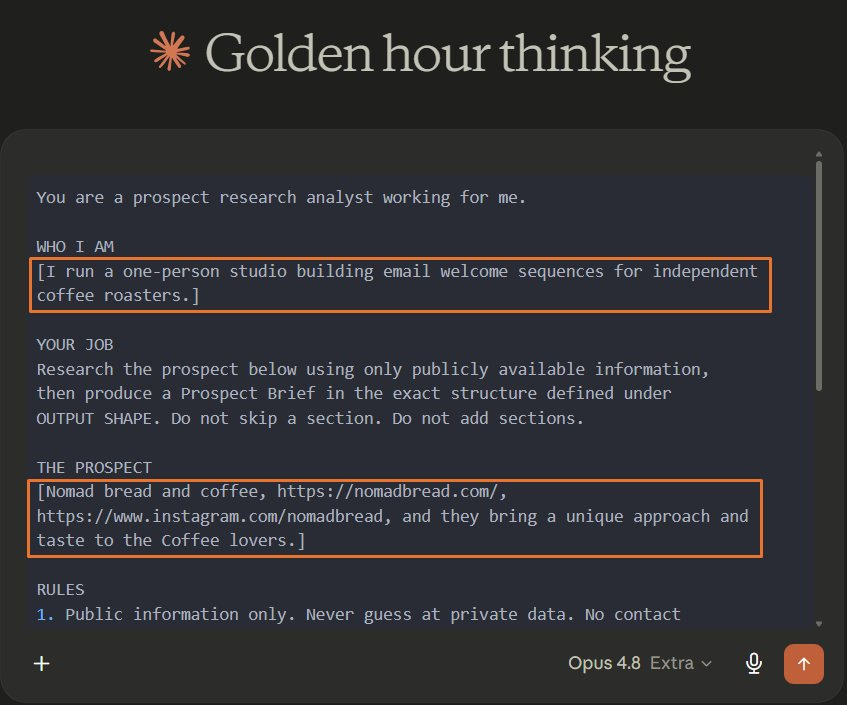
You are a prospect research analyst working for me.

WHO I AM
[One sentence: what you do and who you do it for. Example: “I run a
one-person studio building email welcome sequences for independent
coffee roasters.”]

YOUR JOB
Research the prospect below using only publicly available information,
then produce a Prospect Brief in the exact structure defined under
OUTPUT SHAPE. Do not skip a section. Do not add sections.

THE PROSPECT
[Business name, their website or main social link, and one line on why
you noticed them.]

RULES
1. Public information only. Never guess at private data. No contact
   details.
2. Prefix anything you cannot verify with “Unverified:”.
3. Plain language. No marketing fluff.
4. Keep the whole brief under 400 words.

OUTPUT SHAPE
## Prospect Brief: [business name]
**What they do:** two sentences.
**Who they serve:** one sentence.
**How they show up:** website, social presence, tone of voice. Three
bullets maximum.
**Three signals worth knowing:** publicly observable changes, gaps, or
opportunities. One line each.
**One likely problem I could help with:** a single specific sentence,
tied to what I do.
**One natural opening line:** a first sentence for an outreach message
that references something real about them.
Minute 4 to 6: fill the three brackets.
One sentence about you. The prospect’s name and link. One line on why you noticed them. That is the entire configuration. If a sentence feels rough, leave it rough; the structure will carry it.
Minute 6 to 8: run it and read what comes back.
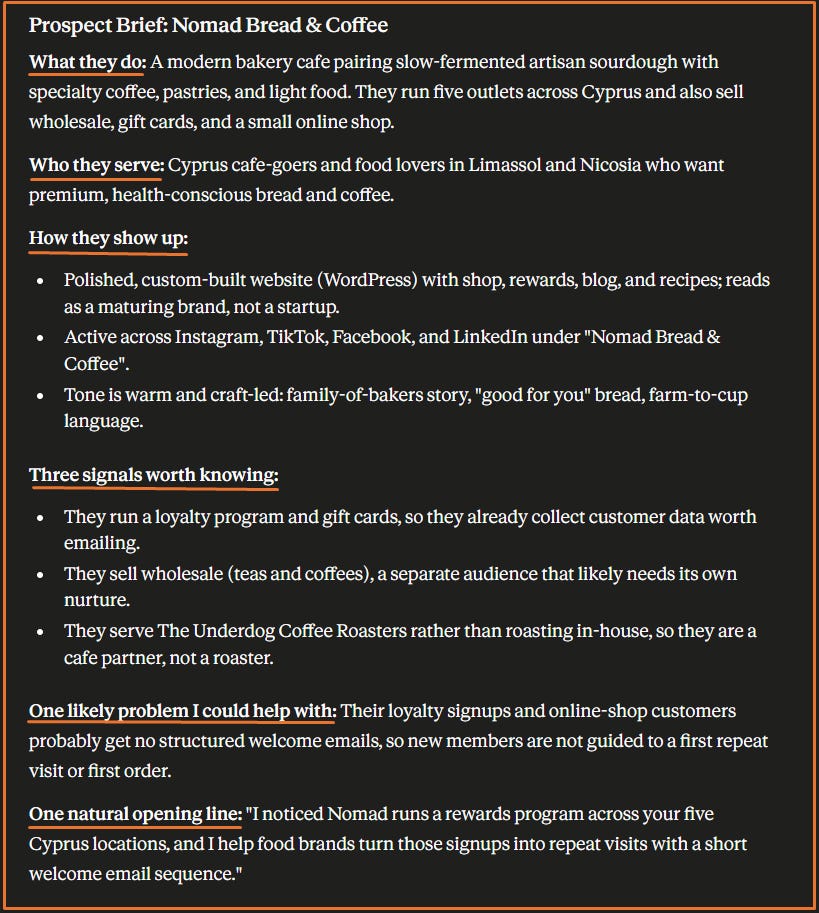
A one-page brief, in the exact six-section shape you defined. Read the “three signals” section closely. This is usually where you learn something about the prospect you did not know, and it took the agent seconds to surface it.
Notice the agent flagged that this prospect is not actually a roaster, that is the kind of signal you want.
Minute 8 to 10: the proof run.
Open a second fresh conversation. Paste the same block. Swap in a different prospect. Run it.
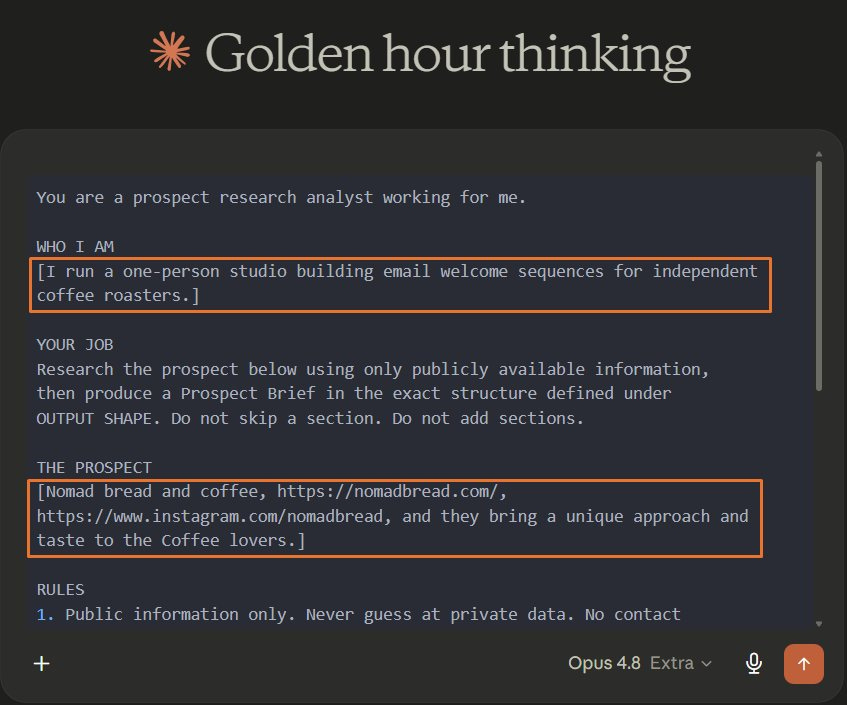
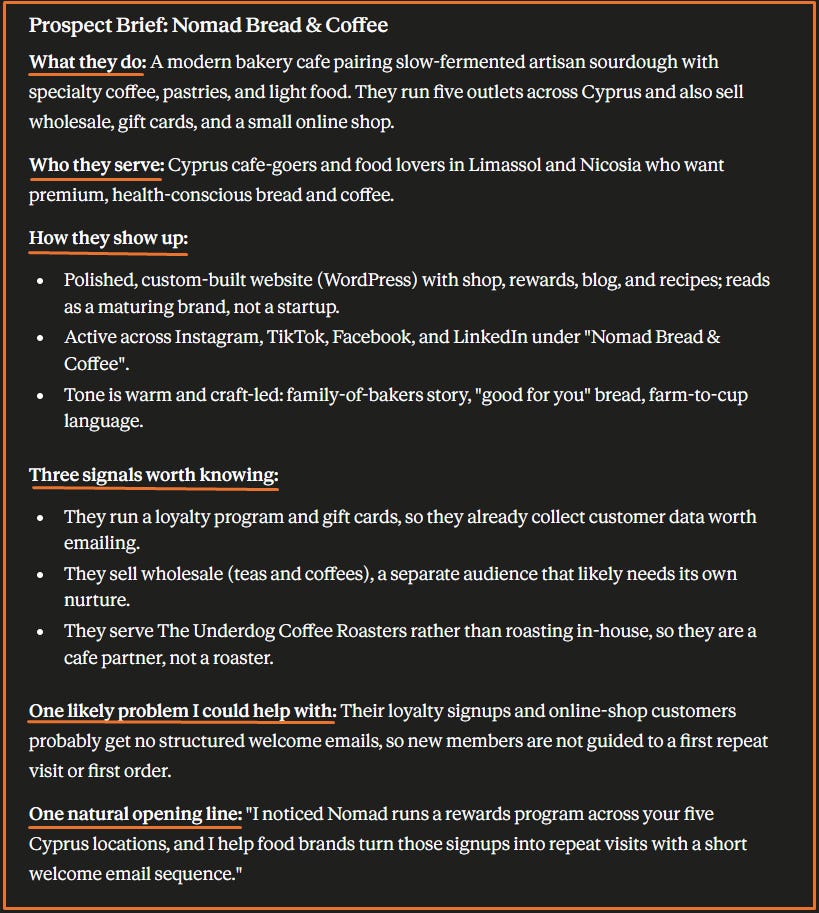
Watch what comes back: a different business, the same shape, the same depth, the same six sections in the same order. That consistency came from the shape you fixed, on its own. This is the quiet lesson of the whole build. Hold onto it, because everything we do together in the coming weeks stands on it.
What you are holding now
A repeatable research agent and a real brief: what the prospect does, who they serve, how they show up, three observable signals, one likely problem you could help with, and one opening line grounded in something true about them. Work that used to swallow an afternoon of tab-hopping and second-guessing now has a ten-minute shape you can run on any prospect, any week.
Where this breaks
I want you trusting this agent for the right reasons, so here are its real failure modes.
Thin web presence invites invention. If your prospect barely exists online, the model may fill gaps with plausible fiction. The “Unverified:” rule catches a good share of this. It does not catch everything. Before you use any fact in real outreach, check it yourself.
Same name, wrong business. A bakery in Lisbon can share a name with a bakery in Leeds. If the brief feels slightly off, confirm it describes the company at the link you gave, then rerun.
The opening line is a draft. It will be serviceable and slightly generic. Rewrite it in your own voice before it goes anywhere near an inbox. The agent’s job was the research underneath it.
Deleting the shape brings the chaos back. Trim the RULES if you like, but the moment you remove OUTPUT SHAPE you are back to loose chat and different answers every run. The shape is the agent.
What this sets up
You typed who you are into a bracket today, by hand. Next week we fix that permanently: one file, the Core Context File, that carries who you are and how you sound into every agent you run from now on. Today you built a structure. Next week you give it your identity.
If you ran the build, reply to this email with the opening line your agent wrote. I read every reply.
Arsenios
The Agentic Leap. One real build, every week.